Aside from the eternal heaven on earth to come into being after the apocalypse, there are certainly other ways to understand “the kingdom of Heaven” in the Gospel of Matthew. This same term is used throughout Mark and Luke as well, but they refer to it as the Kingdom of God.
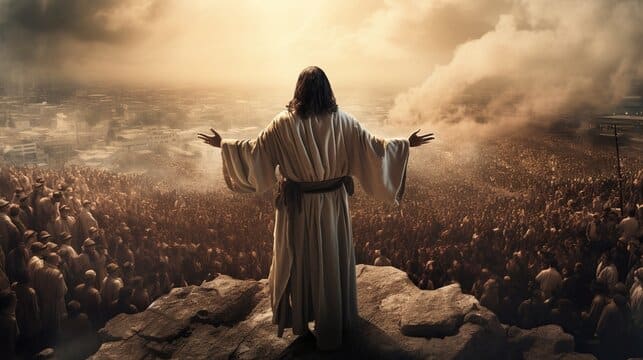
In Mark, the first words out of Jesus’s mouth are, “The time is fulfilled, and the kingdom of God has come near; repent, and believe in the good news.” Theologians, scholars, priests, pastors, and have debated for ages what that means, and to this day those debates are not definitively settled; but there are certainly better arguments to be made for one interpretation or more than another.
In the Synoptic Gospels, Matthew, Mark, and Luke, Jesus spoke about the kingdom of heaven or God in his parables. For example, “the kingdom is like seed sown on good soil, which bears fruit a hundredfold,” or “a mustard seed that grows and becomes the greatest of all shrubs.” If we strictly held to the final judgment discourse found in the Matthew, Mark, and Luke, most of these metaphors found in the parables would refer to the kingdom to come when the world is transformed with the return of the Son of Man. In that case, the kingdom being near would mean it was due to arrive soon. Jesus says in Mark, “Truly I tell you, there are some standing here who will not taste death until they see that the kingdom of God has come in power” (Mark 9:1)
In the Gospel of Luke, however, there is a spot where Jesus appoints seventy-two followers to go out in pairs “ahead of him to every town and place where he was about to go.” He tells them to proclaim, “the kingdom of God has come near” (Luke 10:1). It seems in this case Jesus is indicating that he embodies the kingdom and when he is near, it is near.
Nevertheless, when it comes to scripture, it’s possible that ideas are not as straight-forward as they seem, and there are deeper meanings to be found.
Many millions of people still believe that Jesus will return within their lifetime, bringing about the end of this world as we know it. Today, however, the most popular view among people who believe in a kingdom of God is probably that it is a spiritual realm we will enter after you die. If we have accepted Jesus Christ as our Savior we will enter the literal kingdom of heaven.
My experience, however, has been that we can begin to know this kingdom, this place of God, this realm of Spirit while we are on earth. Said another way, we can understand what Jesus meant by the kingdom by using our own spiritual experience and development as a reference. Perhaps that is what Jesus meant when he said some would not taste death before seeing the kingdom come—if we follow his teachings, seek and ask to find the kingdom, and live the righteous life he prescribes, we will indeed find the kingdom while we are still alive.
There are many English translations that read, “the kingdom of God is at hand,” or have a footnote about it. Perhaps that expression does a better job to convey the spiritual implications of the words-—meaning, the kingdom of God is within our grasp—it is here for us now to find.
Many of these metaphors are open to different interpretations, as well as have universal truths that can apply to more than one area, regardless of the original intention. That is why the kingdom can be understood a variety of ways, as you saw earlier. For example, seen sown on good soil producing a hundredfold could mean that Jesus’ words will result in many entering the kingdom when judgment day comes. Or early Christian missionaries took it to mean they were spreading the seeds to make Christianity grow. Or the words planted within us lead us to live righteous lives and have good harvests in our health, love, or even business.
While none of us his parables are definitely what he meant, see if the following explanations resonate as true with you.
In the first metaphor I mentioned, Jesus speaks of the seed that fell on good soil and produced a hundredfold. This is one of the few parables he actually explains to his disciples and others who did not understand: “the seed is the word of God (or word of the kingdom).” The good soil refers to those who “when they hear the word, hold it fast in an honest and good heart, and bear fruit with patient endurance” (Luke 8:15). In other words, you receive (read or hear) the words of God, and as you reflect on them and come to understand them, their wisdom transforms you for the better. The hundredfold crop produced is your spiritual bounty in a realm called the kingdom of God.
In the other example, Jesus compares the kingdom of God to a mustard seed that, when planted and tended, grows into the greatest shrub. This means when you harbor even the smallest seed of spiritual knowledge within you, you can, by watering it with your attention and seeking, grow and evolve as a spiritual being.
Jesus’ many parables relate to the kingdom of Spirit in different ways, thus providing you with a variety of options to assist your understanding. They are themselves good seed. A parable is only mysterious if you don’t understand what it means, and then you have a few choices. You can accept that you don’t understand it and turn away. You can ask someone to explain it to you, although you might then understand the explanation without internalizing it, which means you might not benefit from it, or, even worse, the person you ask may give you the wrong explanation. Or, you can think about what the parable means, search within, use your intuition, and figure it out. Seek the kingdom, ask for understanding, knock on the door because you want it to open.
For more, check out our blog. For your very own copy of “What Did Jesus Say About Hell?” visit us on Amazon.
seek and u shall find !!