Despite the Gospels and the whole New Testament being filled with talk about the coming Apocalypse and its vivid imagery and absolute judgment of us, it is really hardly ever talked about much….at least in our religious circles. Of course, as I’ve said, there are many churches in the Bible belt and in the south, but probably you can find them in every part of the country, where the end times and the Apocalypse are preached about with regularity.
It is not a surprise and doesn’t say anything negative that we don’t discuss these things. It’s next to impossible to delve into complexities of these subjects in a common 30-40 minute sermon. The beauty of Bible studies is we can do that. All of these subjects we’ve been discussing these past weeks—sin, judgment, the resurrection, heaven, hell—they all tie together don’t they? They interweave in our understanding of God, Jesus, the Bible, and ourselves.
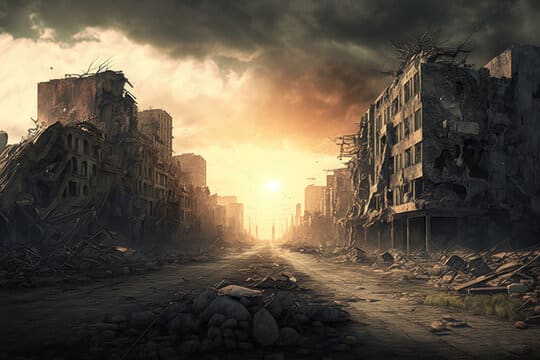
Biblically speaking, we started with sin- what it is and what happens as a result of it. Sin of course ties to judgment; for Jesus said he will separate us as sheep and goats, based on whether we lived in sin or righteousness, which he defined in the Synoptic Gospels as whether or not we loved your neighbors in our hearts and in practice. Judgment of course leads us to the Resurrection. For as it is laid out in apocalyptic terms, judgment is to be realized- actualized- determined- at the end of the world as we know it; when Jesus will return to herald God’s final judgment of humanity. The evildoers will be whisked away to the fire to be burned up; while the righteous will be given immaculate bodies and live in Heaven on earth- Eden- a new earth free of disease, pain, death, sin, and evil. This of course leads to talk of heaven and hell.
Hell is the English name of the place Gehenna, where the evildoers go to be burned up; while heaven, split into two distinct understandings as early Christianity progressed in its first several decades. Heaven started out being the kingdom of heaven on earth; the Eden to be- the new Jerusalem as it is called in the Bible. But then when the end never came, understandings shifted to the heaven above where Jesus and God live. And even Paul’s own writings changed on this matter—in his oldest letters he is very standard apocalyptic. However, the final point made in Paul’s writings and the Bible for that matter, is that you would dwell in heaven only temporarily (be that a year or a thousand years) until that time when Jesus returns to create God’s final eternal kingdom on earth.
We see that change even in the Gospel of John. Whereas Mark, Matthew, and Luke speaks about the final judgment at the end of the world as we know it—the apocalypse (though Luke begins to transition away from that), in John judgment/salvation becomes that those who believe in Jesus Christ, which literally translates, those who believe in Jesus the Messiah, will have everlasting life in heaven above and be with Jesus and God in the afterlife.
How are we to make sense of all these ancient understandings—these words of God—these godly spiritual understandings that indeed hold the truth within them, but also have things that don’t make sense in the understandings of the modern world, which naturally renders some of those ancient understandings seemingly impossible to reconcile? For example, the question they were asking two thousand years ago and every generation since: What are we to make of the fact that the world never ended, and that Jesus hasn’t come back yet, and when is he going to come back?
What are we to make of the fact that Jesus said the end was going to come within that generation, and it never did? How could the Lord be wrong about something? And Paul said it was coming very soon too—so the great apostle and saint Paul was wrong about that too- how can this be?
As concerns the Resurrection, we have questions that the first churches had as well: If we are all to be bodily raised when the time comes, what happens if we were cremated? Well, the early church of the Thessalonians and church of the Corinthians didn’t mention cremation, but as we’ve discussed, Paul does say that the bodies people will get will be like Christ’s body- perfect- shining like the stars in the sky.
In those ancient terms, the buried dead after hundreds of years would be turned to dust same as if you were burned, or likewise if any of the early Christians were martyred for their faith and burned at the stake, surely they too would be raised when the time comes. So accordingly, in modern terms, a God who invented cells, molecules, and the atoms that comprise them, could by godly definition raise a body from a few atoms as well.
To be continued…
For more, visit our blog!
For your very own copy of “What Did Jesus Say About Hell” click here!